
Fall-Injury Prevention Flooring for Aged Care
Falls are the leading cause of injury and loss of independence among older Australians — and most happen on hard, unforgiving floors. Kradal Smart Foam is an impact-absorbing underlay installed beneath standard vinyl: firm to walk and stand on, yet engineered to absorb fall forces by up to 59%. Safety embedded into everyday living, with no change to how the floor looks, cleans, or installs.
Falls are the leading cause of injury and loss of independence
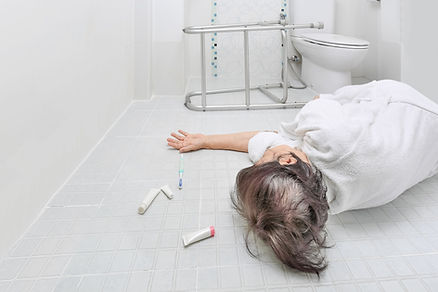
Most assistive-living technology focuses on post-fall response or monitoring. Far fewer solutions address injury prevention at the point of impact. This is what actually keeps residents out of hospital and living independently for longer. Traditional flooring, furniture edges, and vanity surfaces are rigid and unforgiving. A single fall can lead to fractures, loss of confidence, and premature transition into institutional care.
Three zones carry the highest risk:
-
Bathrooms — wet, hard surfaces. Vanity edges, tiled corners, and floors cause head, hip, and upper-body injuries.
-
Bedrooms — night-time falls near bed edges and hard furniture. Residents with cognitive challenges are at highest risk.
-
Circulation areas — hallways and transition zones between rooms, where mobility aids catch and balance is most challenged.
Three products, one passive safety solution
Kradal is more than flooring. It's an integrated assistive-living safety system that embeds protection into the built environment:
-
Kradal Injury-Reduction Flooring — impact-absorbing underlay beneath standard vinyl. Firm to walk on, yet absorbs fall forces by up to 59%. Suitable for all room types, including wet areas.
-
Kradal Soft 90° Corner Edge System — cushioned edge protection for any 90° junction, reducing injury severity from secondary impacts with hard corners and fixtures.
-
Kradal Smart Foam Vanity Top — an impact-absorbing vanity surface for bathrooms that protects against head and upper-body injuries and matches standard cabinet dimensions.
Always-on protection, no compliance required
Unlike wearables or sensor-based alarms, Kradal provides always-on, passive protection. It works the moment it's installed — no charging, no behaviour change, no resident compliance.

Proven Smart Foam technology
Kradal Smart Foam is a specially engineered flexible polyurethane foam designed to minimise fall injuries in elderly environments. The chemical formulation delivers a rare combination: firm to walk and stand on, yet highly impact-absorbent. It's impact-absorbing, waterproof, fire resistant, anti-bacterial and anti-fungal, chemically resistant, 100% recyclable, with 10% renewable content, and an impact sound reduction of ΔLw = 19 dB (EN ISO 717-2).
Construction: a 12mm total installed system — 2mm standard vinyl or linoleum wear surface bonded over a 10mm closed-cell polyurethane impact-absorbing core, glued directly over existing concrete or tile.
No subfloor replacement required, and a wide range of vinyl finishes available.
Scientifically proven injury reduction

Kradal's performance is backed by independent, peer-reviewed research — a 30-month clinical study in a Swedish nursing home, published in Injury Prevention (BMJ Publishing Group).
The study recorded 254 falls on regular flooring versus 77 on Kradal; the injury rate was approximately 30% on standard flooring versus approximately 17% on Kradal. After adjusting for covariates including bone density, Kradal achieved approximately 60% injury reduction. A separate cost-effectiveness model published in the European Journal of Public Health (Oxford University Press) found Kradal reduces costs and increases quality-adjusted life years — a dominant strategy at the societal level.
Gustavsson et al. (2018), Injury Prevention, BMJ · Ryen & Svensson (2016), EJPH, Oxford
Proven cost-effectiveness

Falls are not only a clinical problem — they're a financial one. $5.48 billion was spent on hospitalisations for falls among Australians aged 65+ in 2023 alone, at an average of $37.9K per admission. An independent economic cost-benefit analysis (Axis Economics, 2024) modelled Kradal in aged care facilities and found:
-
5.5× benefit-to-cost ratio at a 5% discount rate
-
~60% reduction in fall injuries (30-month clinical study)
-
Over a 10-year period for a 2,500m² facility: $2.34M attributed to lives saved, $1.61M in hospital costs avoided, and $480K in ambulance costs avoided
Source: Axis Economics — Economic Cost-Benefit Analysis of Kradal Flooring in Aged Care Facilities (2024), based on AIHW injury data, ABS population projections, and clinical trial data.